Article
Affordable Housing and Modular Construction: Why the Math Finally Works in California
California allocates billions annually to affordable housing through TCAC allocations, HCD programs, and local inclusionary requirements. The funding exists. The units do not.
The real problem is production cost and construction timeline. When it costs $600,000 to $900,000 to build a single affordable unit in California major metros and takes 5 to 7 years from site identification to CO, available funding cannot produce units fast enough.
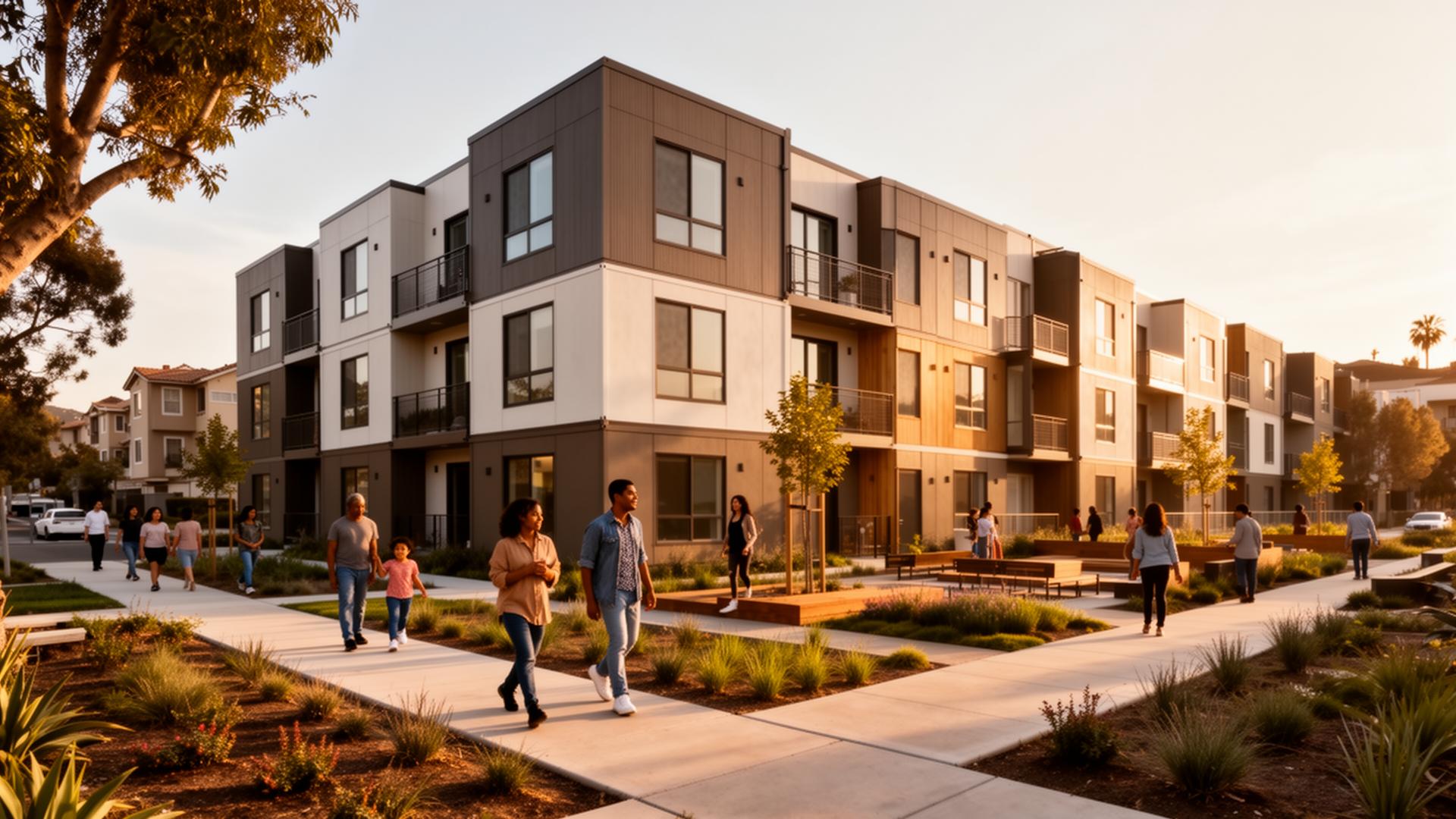
The Gap Has Closed
Three years ago, factory-built modular was 10% to 20% more expensive than comparable stick-built at affordable project scales. That gap has closed. Factory labor efficiency has improved. Material purchasing at factory scale provides procurement advantages unavailable to site-built GCs. California construction labor costs have risen faster than factory labor costs.
> For projects with 30 or more repetitive units, modular is now cost-competitive with stick-built on an all-in basis.
The convergence is driven by three factors working simultaneously. Factory overhead amortizes more efficiently at scale. Stick-built labor costs in California metros have increased 18% to 22% over the past three years. And factory quality control has reduced the rework and warranty costs that historically eroded modular savings.
LIHTC Projects and the Placed-in-Service Deadline
A typical 50 unit affordable project takes 22 to 28 months stick-built from permit to CO and 14 to 18 months modular. That 8 to 10 month advantage represents $400,000 to $700,000 in reduced loan carry, soft cost accrual, and predevelopment holding costs.
LIHTC projects operate under hard placed-in-service deadlines. A modular project delivering 6 months faster is not just cheaper on carry costs. It is the difference between meeting a credit deadline and losing an allocation.
For affordable housing developers managing multiple tax credit projects, the schedule certainty of modular can protect an entire portfolio timeline. One missed placed-in-service deadline can trigger recapture provisions that affect the entire capital stack. The downstream consequences extend beyond a single project to investor confidence and future allocation competitiveness.
The Policy Stack
TCAC basis boost provides more tax credits for qualifying factory-built projects, increasing the equity available to offset development costs. HCD pre-emption skips redundant local inspections, reducing the permitting timeline by weeks to months depending on the jurisdiction. SB 1123 ministerial approval eliminates discretionary review and public hearing requirements.
Together, these create the most favorable regulatory environment for factory-built affordable housing in California history. Developers who are not evaluating modular for their LIHTC pipeline are leaving money on the table.
The Unit Economics
On a per-unit basis, the math is compelling at scale. A 60 unit affordable project using volumetric modular can achieve all-in costs of $350,000 to $450,000 per unit in secondary California markets. The comparable stick-built cost in the same markets is $380,000 to $500,000, with significantly more schedule risk.
The cost advantage widens when you factor in the time value of money. Every month of schedule compression reduces soft costs, carrying costs, and opportunity costs for the developer and the funding sources.
Coordination Is the Remaining Variable
The math works. The policy supports it. The execution challenge is coordination, and that is a solvable problem. Developers who invest in coordination infrastructure before breaking ground consistently deliver affordable modular projects on time and within budget.
The funding is available. The factory capacity exists. The policy environment is aligned. What remains is the discipline to coordinate parallel workstreams with the precision that modular demands.